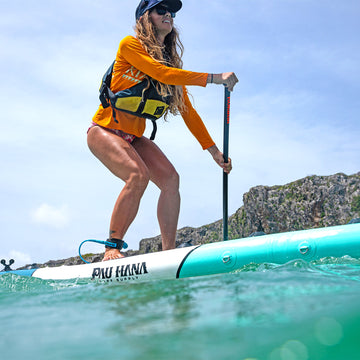


First-Time Paddleboarding: What to Expect on the Water
Your first paddleboarding session is a lot like your first beach day of the season: you think you remember how it goes… and then the wind whips up and reminds you who’s in charge.
The good news? You don’t need to be “athletic” or “a water person” to have an awesome first paddle on a paddle board. You just need a little know-how, the right location, and a willingness to wobble for the first three minutes.
Here’s what to expect from start to finish - so your first time feels less like a guessing game and more like Pau Hana time.
Step 1: The Pre-Paddle Moment (a.k.a. “Did I bring everything?”)
Before your feet even hit the water, there’s a tiny ritual that every paddler learns:
- Leash on (yes, even in calm water)
- PFD / life jacket (wear it or have it on board - always smart and often required)
- Paddle adjusted (more on that in a second)
- Phone + keys secured (dry bag = your best friend)
- Quick conditions check: wind, current, boat traffic
If you want the easiest first session, aim for a body of flatwater: a calm lake, a quiet bay, or a slow-moving river. Save the windy, wavy “character-building” days for later.
Step 2: Your First Launch (and why knee-deep water is the sweet spot)
Most first-timers launch too deep or too shallow.
The sweet spot is knee-to-thigh deep water.
Deep enough that your fin won’t scrape, shallow enough that you can step on calmly without doing a dramatic hop.
What you’ll do:
- Hold the board steady by the side rails.
- Get on one knee at a time (kneeling is your “training wheels”).
- Take 3-5 easy strokes while kneeling to get away from the shore.
That first glide when the board starts moving smoothly - yeah. That’s the hook.
Step 3: The Wobble Phase (totally normal, lasts 1-5 minutes)
You’ll wobble. Everyone wobbles. Even people who look like they don’t wobble wobble.
Here’s what’s happening:
- Your legs are learning to micro-balance
- Your core is waking up
- Your eyes are adjusting to movement on water
The fastest way to steady up:
- Keep your knees soft (don’t lock them straight)
- Look at the horizon, not your feet
- Take shorter paddle strokes and switch sides often
If you feel shaky, stay kneeling a little longer. Kneeling is not “failing.” It’s paddling with a few extra style points.
Step 4: Standing Up (when it feels right - not when someone yells “stand up!”)
When you’re ready to stand:
- Place your paddle across the board in front of you.
- Bring your feet under you, one at a time.
- Rise slowly - like you’re standing up in a canoe.
Where your feet go:
- About shoulder-width apart
- Centred on the board (usually around the carry handle)
Once you’re standing, the goal isn’t “perfect posture.” The goal is to be relaxed and stable.
Step 5: Your First Real Paddle Strokes (and the easiest “secret”)
The most common beginner move is paddling too far away from the board - like you’re trying not to splash it.
Instead:
- Plant the paddle close to the side of the board
- Pull it back, keeping it close to the board, to your feet
- Then lift it out
That’s your forward stroke. Smooth, simple, and way less tiring than muscling through it.
Paddle length quick tip:
A good beginner starting point is 6 - 10 inches above your height, depending on comfort and your boards style. Adjustable paddles make this easy, especially for families sharing gear.
Step 6: Falling In (yes, it might happen - here’s the good version)
If you fall, it’s usually not dramatic. It’s more like: “I’m fine - why am I suddenly swimming?”
How to fall smart:
- Fall away from the board, not onto it
- Try to land flat, not feet-first (especially in unknown depths of water)
- Keep one hand on your paddle if you can (if not, no worries)
And when you climb back on:
- Approach from the side
- Pull your chest onto the board first
- Then wiggle your knees up
You’ll feel like a seal… A victorious seal.
Step 7: The “How Long Should I Go?” Question
For your first time, 30 - 60 minutes is the sweet spot.
You’ll be using muscles you don’t usually use, and fatigue sneaks up fast on water. Ending the session while you still feel good and have energy is how you make paddleboarding a habit - not a one-time experiment.
Step 8: What You’ll Feel After (the best part)
You’ll probably notice:
- A lightly worked core and legs
- Shoulders that feel used (in a good way)
- A calmer brain than when you arrived
That’s why people get hooked. Paddleboarding isn’t just “exercise.” It’s a reset button you can stand on and stare at nature.
A Simple First-Time Checklist (Save This)
▢ Calm water spot
▢ Leash + PFD
▢ Paddle adjusted
▢ Dry bag for phone/keys
▢ Sunscreen + water
▢ 30 - 60 minute plan
▢ Permission to wobble
Your First Paddle Doesn’t Need to Be Perfect
It just needs to happen.
Start close to shore. Keep it chill. Laugh at the wobbles. And when you catch that first smooth glide across glassy water, you’ll get it - why people plan their whole week around that one golden-hour session.
Time to get on the water.